Affichage des articles triés par pertinence pour la requête butterfly. Trier par date Afficher tous les articles

vendredi 27 juillet 2018

From night to light

peacock butterfly caterpillar

Do not be afraid of these black with silver dots caterpillars. They like to feed on Urtica dioica, its preferred plant with hop.

peacock butterfly caterpillar

I will keep some areas with urtica because they will give life to the nice peacock butterfly and many other butterflies.
peacock butterfly


More insects among other butterflies of the Sant valley.

jeudi 31 août 2017

Miss Common blue


common blue butterfly South of France


This shining like silk and soft like velvet butterfly is Polyommatus icarus or Common blue. Only males usually have iridescent lilac blue with a thin black border uppersides. The female, pictured here, is brown above with a row of red spots along the edges and usually some blue at the base of the wings; the extent of blue and brown is extremely variable; Undersides have a greyish ground colour in the males and a more brownish in the females.
This species is widespread over much of the Palaearctic in temperate Asia and Europe.
These butterflies inhabit flowery or grassy places, warm and cool, open or wooded areas and at all altitudes up to high alpine meadows at an elevation of 0–2,700 metres above sea level.
The larva feeds on plants from the family Leguminosae (bean family).
The caterpillar is small, pale green with yellow stripes. They are attractive to ant, but not as much as some other species of blues. The chrysalis is olive green/brown and formed on the ground, where it is attended by some ants’ genera which will often take it into their nests. The larva creates a substance called honeydew, which the ants eat while the butterfly lives in the ant hill.


The orange spot on the upper right part is a butterfly too: the Jersey tiger.


Other butterflies of our valley: here

vendredi 1 novembre 2019

Les papillons se ramassent à la pelle

papillon paon de jour peacock butterfly

C’est l’automne, il faut balayer les feuilles mortes. Ce faisant devant la porte d’entrée, quelle belle récompense : un papillon paon de jour en train d’hiberner et dérangé par mon ménage s’est mis à grimper sur le mur, une vraie merveille !

Nous en voyons souvent l’été et je leur ménage des ronds d’orties pour leurs chenilles.

Puis il s’est envolé à la recherche d’un autre refuge. J’espère le revoir au printemps.

Le revers des ailes est moins chatoyant mais très chic.

papillon paon de jour peacock butterfly

Découvrez d’autres insectes et notamment les papillons de la vallée du Sant.

While sweeping the dead leaves in front of the entrance door, a peacock butterfly escaped and climbed the wall. A real jewel!
We see many of them around during late spring and summer and I keep places with nettles to help their caterpillar feeding.
Then it flew away to find a new shelter. Hope I”ll see it again next spring.

More insects among other butterflies of the Sant valley.

dimanche 14 août 2016

Flying zebra

The Scarce Swallowtail (Iphiclides podalirius) is a Palearctic swallowtail butterfly found in gardens, fields and open woodlands.

Its Latin name comes from Podalirius, son of Asclepius, god of medicine in ancient Greek mythology. With his brother, Machaon (name given to a closely related butterfly), he was highly valued surgeon and medic in the Trojan War on the side of the Greeks and took part of the Trojan horse commando.
It is also called Sail Swallowtail due to the form its wings when at rest.


It is widespread throughout Europe, with the exception of the northern parts, and eastwards across Asia Minor and Transcaucasia as far as the Arabian Peninsula, Pakistan and the Republic of India, and western China. A few specimens of the Scarce Swallowtail have been reported from central Sweden and the UK but they were probably only strays and not migrants. The scarcity of UK migrants is responsible for the English common name.

The Scarce Swallowtail is getting rarer as the blackthorn bushes are being cleared. The butterfly is now protected by law in several European countries.


Other butterflies of our valley: here

lundi 9 octobre 2017

Flying flower

Large white butterfly

Between two mushrooms, found these last days, here is Pieris brassicae, the large white, also called cabbage butterfly or cabbage white, on a Geranium nodosum.
The large white is common throughout Europe, North Africa, Asia and even through the Himalayas. Its migration patterns are typically observed only when there is a disturbance.
For both males and females, the wings are white with black tips on the forewings. The female also has two black spots on each forewing. The underside of each wing is a pale greenish and serves as excellent camouflage when at rest.
This female has eyes as psychadelic as the eyes of the orange tip.
The large white butterfly's habitat consists of large, open spaces, as well as farms and vegetable gardens, because of the availability of its food source. Some favoured locations include walls, fences, tree trunks... They primarily hover around these locations, which should contain both wild and cultivated crucifer, as well as oil-seed rape. It is still considered a pest in some European countries, in China, India, Nepal, and Russia.
Two generations of butterflies are produced each year, sometimes, a third brood can be observed farther along in the summer if the weather is warm enough.

More insects among other butterflies of the Sant valley.

samedi 25 février 2023

L'été à la menthe

papillon cuivré et guêpe coucouFeu d’artifice de couleurs sur une gerbe de menthe.

Devant la maison, comme l’est la marjolaine près de laquelle ils se trouvent, les pieds de menthe sont de véritables aimants à insectes. J’en découvre toujours de nouveaux parmi les dizaines d’espèces qui viennent s’y délecter à tout moment de la journée.

L'été dernier j’y ai trouvé un beau papillon Cuivré et une guêpe coucou en technicolor de la famille des Chrysididae.

Le papillon pourrait être soit un cuivré commun ou Lycaena phlaeas soit une femelle du cuivré fuligineux (Lycaena tityrus) que nous avions déjà rencontré et qui est de la même famille.

Le nom d’espèce phlaeas viendrait du grec φλέγω (phlégo), "bruler", ou du latin floreo, "fleurir"

Je n’ai pas effectué de mesure de la guêpe coucou or il est difficile de différencier les deux espèces proches Hedychrum nobile et Hedychrum niemelai qui est de couleur et de forme semblable, quoique de taille plus petite.

L’attribut « coucou » vient du fait que ces guêpes parasitent d’autres insectes en leur dérobant notamment leurs réserves de nourriture. Hedychrum nobile parasite la guêpe Cerceris arenaria.

Le nom de famille des guêpes coucou (Chrysididae) fait référence à leur corps brillant et vient du grec “chrysid », habillé d’or, notion que l’on retrouve pour les noms de ces espèces dans de nombreuses langues. Comme pour les beaux papillons bleus morphos, leurs couleurs metalliques sont en fait dûes à des mécanismes d’iridescence et non à des pigments.

Découvrez d’autres insectes et notamment les papillons de la vallée du Sant.


On these white flowering whorls of mint I enjoyed colorful fireworks of insects last summer.

Lycaena phlaeas, the small copper, American copper, or common copper, is a butterfly of the Lycaenids butterfly family. It is very similar to the female of Lycaena tityrus we already met. According to Guppy and Shepard (2001), its specific name phlaeas is said to be derived either from the Greek φλέγω (phlégo), "to burn up", or from the Latin floreo, "to flourish".

Hedychrum nobile or niemelai (not easy to distinguish too) is a species of cuckoo wasps in the family Chrysididae with brilliant metallic colors. The term "cuckoo wasp" refers to the way in which wasps in the family lay eggs in the nests of unrelated host species because they are  parasitoid or kleptoparasitic wasps.

The shining coloration made of iridescent blue, green, purple is an interference coloration, while true pigments (red, brown and white) are very rare. The typical brilliance is emphasized by the exoskeleton sculpture, which is carved by a complex punctuation and by projections, crests, holes from micrometric to millimetric size.

Chrysididae, the scientific name of the family, refers to their shiny bodies and is derived from Greek chrysis, chrysid-, "gold vessel, gold-embroidered dress", plus the familial suffix -idae. The common names of many species pay similar tribute to their appearance: jewel wasp, gold wasp, emerald wasp, ruby wasp and so on (French guêpe de feu, "fire-wasp")

More insects among other butterflies of the Sant valley

samedi 10 août 2019

Petite lutine

papillon petite sylvaine skipper butterfly

Nous connaissons déjà le Sylvain azuré, voici la Sylvaine (Ochlodes sylvannus). Ce n’est ni sa compagne ni sa petite sœur, mais bien une autre espèce. Comme lui, son nom dérive du latin « silva, silvae », forêts.
On la trouve dans toute l’Europe tempérée. Elle aime les prairies et les lisières, mais aussi, comme on le voit ici, les fleurs des hortensias du jardin.
Sur la base de la couleur des antennes, il s’agit probablement d’une femelle, mais il faudrait voir le dessus des ailes pour s’en assurer : les mâles ont une nervure noire épaisse constituée d’écailles odoriférantes (phéromones).
Le revers de l'aile postérieure est jaune verdâtre, marqué de taches plus claires peu distinctes. Ce caractère permet de distinguer la Sylvaine des espèces européennes ressemblantes : les Thymelicus qui n'ont pas de taches sous l'aile postérieure, et la Virgule chez laquelle ces taches sont blanc nacré.
Le corps est trapu ; les antennes sont largement séparées à leur base et, détail amusant, crochues à leur extrémité.
La Sylvaine a un vol très rapide. Lorsqu'elle se pose les ailes ouvertes, les ailes antérieures sont rabattues de façon oblique, masquant les ailes postérieures.
Découvrez ici d’autres insectes et notamment les papillons de la vallée du Sant.

Here is the nice Large skipper (Ochlodes sylvannus), its name comes from the Latin word “silva, silvae”, forests. It can be found in Europe anywhere where wild grasses are allowed to grow tall. Hedgerows, woodland clearings and edges are favourites.
Although called "large" this is still a relatively small butterfly. The body is rather squat. The antennae are hooked at their tips.
The male has a broad scented androconial dark line across the top of the forewings. On the hindwings of the females there are brighter square marks.
The upperside of the wings is orange-brown with a brown border and some lighter spots. The underside of the hindwings is greenish-yellow, marked with sparse yellow spots. This helps to avoid confusion with the Silver-spotted skipper (which has white dots) and with the Small skipper (with no spot at all).
When the wings are opened, the forewings are obliquely folded, masking the hindwings.
Here: more insects among other butterflies of the Sant valley.

lundi 11 avril 2016

Peacock butterfly

With the sunny spring days, all sorts of butterflies can be seen around here.


Let’s begin with the European Peacock (Aglais io), more commonly known simply as the Peacock butterfly.
It can easily be recognized with its colorful eye-spots on every wing, similar to peacock feather, explaining its name.

The other side of the wings is grey/brown. In order to avoid observation or detection by other animals, it blends into its environment by mimicking a leaf and staying immobile, particularly during hibernation (crypsis).
The Peacock is common here and can be found along the creek, in woods, fields, meadows and pastures. It can have up to three generations per year and hibernates over winter in attics, wood piles or holes in stones.
Saturnia pyri, the giant peacock moth, with eyespots too, has darker colors because it flies at night.


Other butterflies of our valley: here

lundi 29 août 2016

Sexy butterfly


The silver-washed fritillary (Argynnis (ex Dryas) paphia) is deep orange with black spots on the upper side of its wings. The male possesses scent scales (androconium) on the upper side of the forewing that run along veins one to four. The scent produced from these scales is a pheromone and attracts females and helps to distinguish it from other species.

Adults mainly feed on the nectar of bramble, thistles, and knapweeds, and also on aphid honeydew. It is pictured here on Eupatorium cannabinum. Its preferred habitat is thin, sunny, deciduous woodland, especially oaks.
Unusually for a butterfly, the female does not lay her eggs on the leaves or stem of the caterpillar's food source (in this case common dog violets), but instead one or two meters above the woodland floor in the crevices of tree bark close to clumps of violets. When the egg hatches in August, the caterpillar immediately goes into hibernation until spring. Upon awakening, it will drop to the ground, and feeds on violets close to the base of the tree. It will make its chrysalis amongst the ground vegetation, and the adults will emerge in June.

The silver-washed fritillary is found over much of the Palearctic Eco zone – Algeria, Europe, temperate Asia and Japan. It was in decline in the UK for much of the 1970s and 1980s, but seems to be coming back to many of its old territories.


Other butterflies of our valley: here

lundi 27 juin 2016

Flying tortoise

It is not only in Terry Pratchett’s novels that you can find flying tortoises.

The blackleg tortoiseshell or large tortoiseshell (Nymphalis polychloros) is a butterfly of the family Nymphalidae.
Tree sap and damaged ripe fruits are particularly suitable sources of food for this butterfly. The females lay their pale green eggs in a continuous band around the upper twigs of elm, sallow, pear and prunes trees.
It is found in Europe, northern Africa, and western Asia. It is an extreme rarity in Britain, although it used to be widespread throughout England and Wales.
It looks very like the small tortoiseshell (Nymphalis urticae), here left, with some differences in numbers and colors of the spots:


Other butterflies of our valley: here

lundi 30 mai 2016

Wonderful surprise

After a day working in the garden, I was just coming back when I suddenly saw this wonderful butterfly at the bottom of a fern.


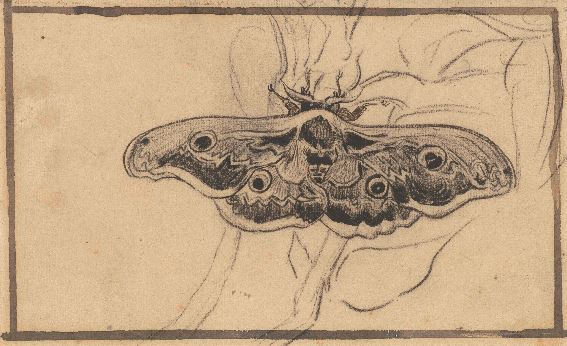
It is a giant peacock moth, Saturnia pyri, also called the giant emperor moth, the largest European Moth.
As the European peacock we already met (post dated 11 April in Fauna & Flora), it has eyespots on the body which resemble a peacock feather, origin of its name. These spots mimic eyes to deceive potential predator.
Like many butterflies living at night, it never eats. The adults fly from April to June and live only a week dedicated to reproduction. The male has big antenna and can detect a female several kilometers around.
Because this butterfly is so beautiful, Vincent Van Gogh decided to paint it:


In a letter to his brother he wrote: “Its coloration is astonishingly distinguished: black, grey, white, shaded, and with glints of carmine or vaguely tending towards olive green; it’s very big”.

He drew the moth with black chalk and then used a fine pen and brown ink to fill in the legs and antennae. He used brown ink to accentuate the dark parts of the moth. He used the same ink with a pen and brush to draw a frame around the image. In his notes he explains why he intentionally decided to draw the moth instead of making a painting of it:
“To paint it I would have had to kill it, and that would have been a shame since the animal was so beautiful”.


Other butterflies of our valley: here

mercredi 28 juin 2023

Petit rhinocéros volant

Papillon Alabonia geoffrella butterfly
Comme le petit Adela australis que nous avons déjà rencontré, l'Œcophore nervurée (Alabonia geoffrella) est un tout petit papillon de jour d'une envergure d'environ 2 cm.

Avec son cousin A. staintoniella (qui n’a pas le bord des ailes noires notamment), il est très facile à différentier des autres petits papillons grâce aux décorations sur ses ailes et ses très longs palpes labiaux noirs à pointe blanche recourbés vers l’arrière en forme de corne de rhinocéros.

L'imago vole le jour en mai-juin. Cette espèce européenne vit dans les régions boisées et de marais. La chenille dans le bois vermoulu notamment dans celui du noisetier (Corylus avellana) et de la ronce à mûres, tous deux très communs ici.

Découvrez d’autres insectes et notamment les papillons de la vallée du Sant. 

Like the Adela australis we already met, Alabonia geoffrella is a small colorfull day-flying moth with a delicate metallic-blue pattern (around 2 cm). With the other Albonia (A. staintoniella which lacks the dark lines in the terminal part of the wings.) it is easy to distinguish from other moths with its labial palps which are conspicuously enlarged and curbed like rhinoceros horns.

The adults fly from May to June depending on the location in Europe, where it is not rare in many woodlands and marshlands.

The caterpillars feed on rotting wood; mostly living under tree bark of common hazel (Corylus avellana) and blackberries, many are here around.

More insects among other butterflies of the Sant valley 

jeudi 19 mai 2016

The flying leaf

The brimstone (Gonepteryx rhamni) is one of the first butterflies early in spring. Its name comes from its yellow color similar to sulphur. Its wing shape is unique to act as camouflage and it never settles with its wings open. In the picture here the upper side is visible thanks to a shooting at the very moment it escapes from a Violette.

It is a male because the upper side is yellow while the female is white with a greenish tinge, but both have an orange spot in the center of each wing.


It lives in Europe, except in the extreme north, in North Africa and in Asia. In many of European countries, its common name refers to its color too but compared to lemon, papillon Citron in French, Zitronenfalter in German, Citroenvlinder in Dutch and Listkowiec cytrynek in Polish.
It is one of the longest lived butterflies, living up to thirteen months, although most of this time is spent in hibernation (outdoor contrary to most butterflies in that case). The brimstone usually hides until early spring, although a warm January day will occasionally wake an eager male.

The name "butterfly" is believed to have originated from the brimstone which was called the butter-coloured fly by early British naturalists.


Other butterflies of our valley: here

mardi 4 février 2020

Les petits miroirs du soleil

ecailles d'ailes de papillon
 Ecailles d’ailes de paon de jour au microscope (x400)
Scales on peacock butterfly wings under microscope (x400)

Une récente étude publiée le 28 janvier 2020 dans la revue scientifique Nature analyse la magie des ailes de papillons en rajoutant de nouvelles fonctions à celles déjà connues et notamment la présence d'un extraordinaire "coeur pulsatile" pour faire circuler l'hémolymphe (sang des insectes).

Découvrez d’autres insectes et notamment les papillons de la vallée du Sant.

A new study published on January 28 in Nature adds more functions to the butterflies wings on top of those already known and shows an amazing "living heart" in the wings that allows hemolymph transport.
More insects among other butterflies of the Sant valley.

vendredi 1 janvier 2016

Belle et heureuse année / Happy new year/ Bona annada*

J’ai choisi un joli Petit Sylvain (Limenitis camilla) qui voletait dans la forêt cet été pour venir vous souhaiter une année 2016 aussi belle, colorée et légère en soucis que lui.


I elected this nice White Admiral (Limenitis camilla) pictured in my forest last summer to wish you a year as beautiful, as colourful and as peaceful than this little butterfly.

* Occitan (prononcer Boun annado)

lundi 30 mars 2020

Léger visiteur du matin

papillon aurore orange tip

J’avais déjà rencontré la femelle du papillon Aurore (Anthocharis cardamines) qui, elle, n’a pas le bout des ailes de couleur orange.
J’ai longtemps courru après des mâles, beaucoup trop vifs. Celui-ci était enfin plus calme et s’est laissé approcher doucement.
Nous avons beaucoup de ces jolis petits visiteurs car leurs chenilles aiment les cardamines (d’où son nom d’espèce) et des alliaires, très répandues le long du ruisseau.

After the female, I finally made a picture of the male of Anthocharis cardamines, many have been too quick for me up to now. Only males have orange on top of the wings, giving its common name to this butterfly : the orange tip.
We see many of them here because females lay eggs on the flowerheads of cuckooflower (Cardamine pratensis) or garlic mustard (Alliaria petiolata), very common on the river side.

papillon aurore orange tip

Découvrez d’autres insectes et notamment les papillons de la vallée du Sant.
More insects among other butterflies of the Sant valley